Send Us a Text
Use the form below to send us a text.

A pintle hitch is a specialized towing device designed to provide a highly secure and versatile connection between a towing vehicle and a trailer. Unlike the more common ball hitch, the pintle hitch uses a hook and lunette ring mechanism, which allows for greater articulation and flexibility during towing. This design is particularly suited for heavy-duty applications, off-road environments, and situations where the terrain or load demands a robust coupling system.
At its core, the pintle hitch consists of a heavy-duty hook mounted on the towing vehicle’s rear frame, which locks into a lunette ring attached to the trailer’s tongue. This connection allows for a strong and stable link, capable of handling substantial loads with ease. The lunette ring’s circular shape enables the trailer to pivot freely around the hook, accommodating sharp turns, uneven surfaces, and rough terrain without compromising safety or control. This articulation is a key advantage, making pintle hitches highly favored in military, agricultural, industrial, and construction settings where road conditions are less predictable.
The benefits of a pintle hitch extend beyond its ruggedness and flexibility. One of the most significant advantages is its high towing capacity. Pintle hitches typically support heavier weights than standard ball hitches, often exceeding 20,000 pounds in gross trailer weight. This makes them ideal for towing large utility trailers, heavy equipment, or industrial machinery. Additionally, the robust construction of pintle hitches ensures durability and longevity, even under harsh environmental conditions and frequent use.
Another practical benefit is the simplicity of the coupling mechanism. The hook-and-ring system is easy to engage and disengage, which can speed up hitching and unhitching processes on job sites or during frequent trailer swaps. The design also tends to be more resistant to accidental uncoupling, providing an extra layer of security during transit.
Despite their advantages, pintle hitches are not typically suited for all towing scenarios. Their rugged design can lead to a rougher ride on paved roads compared to ball hitches. However, for users who prioritize strength, durability, and off-road capability, pintle hitches offer unmatched performance.
In summary, a pintle hitch functions as a heavy-duty, flexible coupling device that excels in demanding towing environments. Its robust hook-and-lunette ring design provides superior articulation and weight capacity, making it the preferred choice for industrial, agricultural, and off-road towing needs. Understanding these functional benefits helps users make informed decisions when selecting the right towing equipment for their specific applications.
When deciding between a pintle hitch and a ball hitch, understanding their key differences is essential to matching your towing requirements. Pintle hitches use a hook and lunette ring system, designed primarily for heavy-duty and off-road towing. They provide excellent articulation, allowing the trailer to pivot more freely over uneven terrain, which is why they’re favored in construction, agriculture, and military applications. This design supports heavier loads and rougher conditions but can result in a rougher ride on paved roads.
Ball hitches, in contrast, consist of a ball mount on the towing vehicle that fits into a coupler on the trailer. They are the most common choice for everyday towing, offering smoother towing performance on highways and paved surfaces. The ball hitch’s simplicity and widespread use make it ideal for recreational trailers, boats, and lighter utility trailers.
In terms of weight capacity, pintle hitches generally support higher gross trailer weights compared to ball hitches of similar size, thanks to their robust construction. However, ball hitches are often preferred for lighter, more frequent towing where comfort and ease of hookup are priorities.
Maintenance and ease of use differ as well. Ball hitches require less frequent lubrication and offer quicker coupling and uncoupling. Pintle hitches demand regular inspection and greasing to ensure safe operation, especially in off-road conditions.
For drivers in Lexington and surrounding areas who need reliable, heavy-duty towing equipment, pintle hitches from Trailer Liquidation Direct are an excellent choice. To explore the right hitch for your towing needs, visit us at 1723 Old U.S. Hwy 52, Lexington, NC 27295 or call us at (336) 537-5851 to discuss your towing setup and get expert recommendations tailored to your vehicle and trailer.
Pintle hitches come in several variations, each designed to address specific towing challenges and environments. The primary types include fixed pintle hitches, lunette ring couplers, and adjustable pintle hooks:
Some pintle hitches include safety features such as locking mechanisms to prevent accidental uncoupling, as well as heavy-duty latches designed for high-impact resistance. Certain models also integrate with weight distribution systems to better manage tongue weight and improve vehicle handling.
Understanding these types helps users select the right pintle hitch based on their towing demands, vehicle type, and terrain. For example, fixed pintle hitches excel in rugged environments, while adjustable models offer flexibility for mixed-use towing. This selection process ensures safe, efficient towing tailored to specific operational conditions.
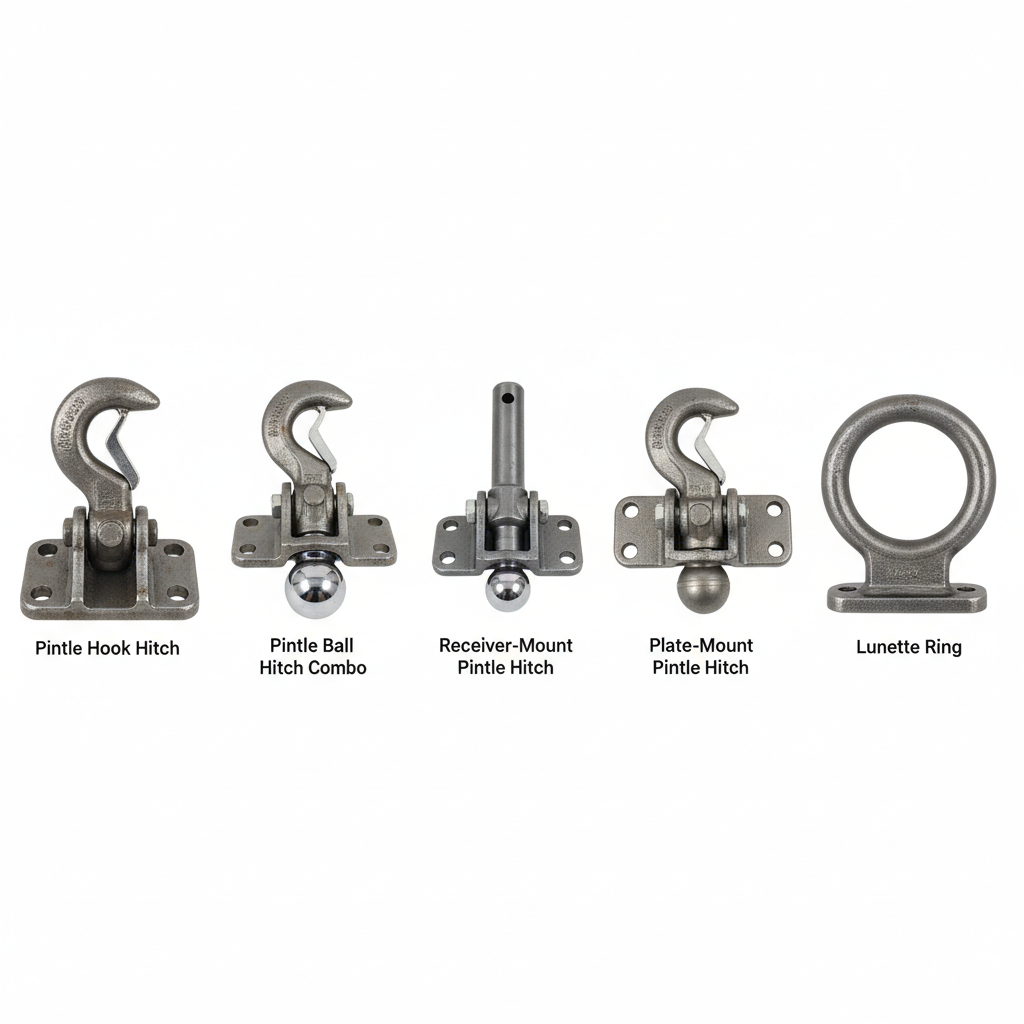
Pintle hitches are engineered for heavy-duty towing applications, boasting impressive weight capacities that surpass many conventional hitch types. Typical pintle hitch ratings range from 10,000 to over 30,000 pounds in gross trailer weight (GTW), depending on the model and manufacturer specifications. This high capacity makes pintle hitches especially suitable for towing large trailers, military equipment, construction machinery, and other substantial loads. The robust hook-and-lunette ring connection provides a secure coupling capable of withstanding significant stresses, especially in off-road or uneven terrain conditions.
Alongside gross trailer weight, understanding tongue weight, the downward force exerted on the hitch by the trailer, is critical. Pintle hitches generally support tongue weights from 1,000 to 3,000 pounds or more. This range accommodates the heavy front loads often encountered with industrial or agricultural trailers. Maintaining the correct tongue weight is essential for safe towing; too little tongue weight can cause trailer sway, while excessive tongue weight can overload the vehicle’s rear suspension and compromise handling.
Because pintle hitches are designed for rugged use, many models include heavy-duty mounting plates and reinforced components to distribute these loads effectively across the vehicle’s frame. It’s crucial to consult both the hitch’s manufacturer guidelines and your vehicle’s towing capacity to ensure safe operation. Overloading beyond specified ratings risks mechanical failure and safety hazards.
Regular inspection for wear, proper installation, and adherence to weight limits are key to maximizing the lifespan and reliability of pintle hitch systems. This makes pintle hitches a dependable choice for demanding towing tasks that require both strength and flexibility.
Ensuring a pintle hitch is installed correctly is crucial for safe towing. Begin by securely mounting the hitch to your vehicle’s frame, using manufacturer-recommended bolts and torque specifications. Incorrect installation can lead to structural failure or unsafe towing dynamics. Always verify that the hitch aligns properly with the trailer’s lunette ring to avoid excessive wear or accidental uncoupling.
Routine maintenance plays a vital role in prolonging hitch life and safety:
Following these installation and upkeep guidelines will help maintain reliable performance and safety during all towing operations.